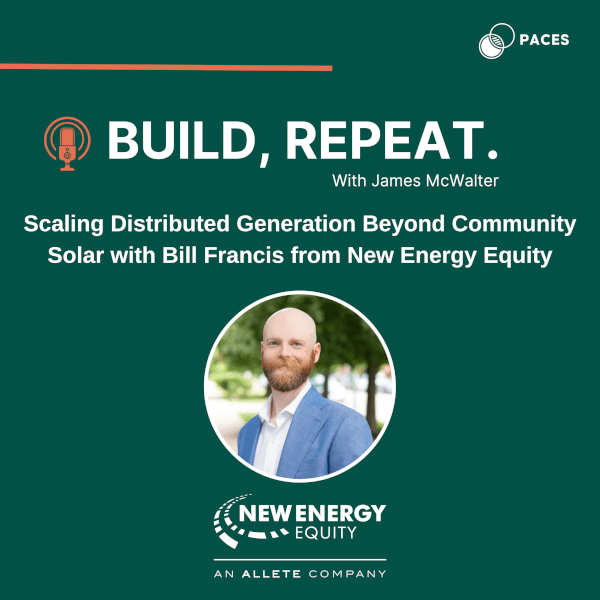
Bill Francis, Vice President of Emerging Markets at New Energy Equity, joined the Build, Repeat podcast in April to discuss the future of distributed generation beyond community solar. You can listen to the interview with James McWalter of PACES on Spotify and Apple Podcasts. The full transcript is included below.
James McWalter: Welcome to Build Repeat, a Paces podcast. Join us every few weeks for deep discussions with the leaders and innovators helping us build our way out of climate change. Hello today we're joined by Bill Francis, Vice President of Emerging Markets at New Energy Equity. Welcome to the podcast Bill.
Bill Francis: Hey, thanks James, and happy to be here.
James McWalter: Amazing. Well we are very excited to have this call New Energy Equity has been, you know, a really great partner to Paces over the last few years and I know you recently joined them. Um so yeah would love to learn a bit about how you ended up at New Energy Equity um because you've been at a lot of great firms over the years.
Bill Francis: Well, it's kind of an interesting story. So I really began my career in renewables through battery storage about 10 years ago when it was sort of early days for battery storage. So I got into solar actually through batteries rather than the reverse, which is maybe more common amongst your listeners and in the industry. You know, I had the good fortune of moving out of a, we'll call it brown power company on the retail side of American Electric Power, the utility, into a battery storage analyst position at SoCore Energy, which was a Chicago-based distributed solar developer. I moved into Engie North America as Engie acquired SoCore Energy from Edison International in 2018 and spent the next seven years basically at Engie, all the way up until the end of 2025. So I actually had quite a long run at Engie. It was a lot of fun, did a whole bunch of different things there and probably would have stayed if not for the fact that someone at New Energy Equity, named Jackie Chambers, called me and is someone who I had known for a long time and said, 'Hey, you know, we're looking for somebody to come do some new market stuff and help us learn about batteries.' And so, you know, a few months of conversations later, here I am, very excited to be here. Kind of a weird windy path, but probably a lot of your listeners can identify with that.
James McWalter: Absolutely. Looking at your stint at Engie, you literally exactly lined up in the few months pre-Inflation Reduction Act and then, you know, and then obviously relatively... It's very like book-ended by that period of time, which is kind of an interesting period.
Bill Francis: I've never thought about it that way.
James McWalter: Yeah, yeah. Um, but I guess before we kind of go back there, yeah, would love to, you know, the title Vice President of Emerging Markets, what does that mean and what is an emerging market from your perspective?
Bill Francis: Look, emerging markets to NEE, at least in the context of my position, means we'll call it non-traditional community solar. So New Energy Equity historically has been primarily a developer of community solar projects in markets with those state policy enabled programs. A lot of what I had done at Engie, almost all of what I had done at Engie, was distributed solar and storage focused, but not all of it was community solar. Some of it was cooperative and municipal PPA projects, some of it was other state programs, other tariff structures, ways to commercialize distributed solar and batteries not just in traditional community solar programs. And so New Energy Equity, you know, I think rightfully is understanding that we're not going to keep seeing two or three new community solar programs every year, and the ones that exist are becoming quite challenging, programs are getting saturated. So outside of some of the markets like Illinois and New York and Maryland maybe with some legs, you know, we're going to start to see other ways to commercialize distributed solar and I'm here to help do that alongside frankly get them going on battery storage.
James McWalter: Yeah, you know, I think it's been a fascinating few years. You know, a lot of customers of Paces and folks we know in the industry made, you know, various levels of calculated bets on emerging community solar markets, right? You know, I think a lot of folks are familiar with the Arizona, California, Iowa of it all, right, and then other places like Ohio, PA, and et cetera. And I guess, you know, one of those programs that did not quite come to fruition as people expected has a different set of underlying factors. But as you, you know, if you go back to, you know, your early days at Engie as you're kind of, you know, starting out and Inflation Reduction Act has just passed and things are kind of ramping up, what I guess surprised you versus your kind of expectations at that time for how that market was going to evolve?
Bill Francis: Oh, that's an interesting question. How did it match up with my expectations? You know, I'm not sure I had really formed expectations back, you know, in the early part of my career there, at least the early mid part of my career. I was perhaps like all of us like riding the roller coaster a little bit. And so in a lot of ways, I think we maybe thought, maybe naively at the time, that we were going to be able to unlock a lot of new programs and frankly we did. You know, Illinois, my home state, I consider a huge win, the last kind of three rounds of legislative process ending in CEJA, which was signed earlier this year, you know, has been like a great story over the course of the last several years and how much that program has expanded and the durability of the program. You know, I think my expectations were maybe that we'd get two or three or four more of those and we didn't, but I don't know that that necessarily means that we don't have opportunity. Uh, we could talk about that later, but I think, you know, maybe the expectation was a little bit like it was going to look the same state by state or more the same and what I think is likely to happen is it's actually going to look a little bit different, but I don't think the opportunity is quite gone.
James McWalter: Then do you think this kind of next wave of growth for community solar, will that or community scale I guess clean energy, like that look different? You know, I think there are these, more and more of these programs I think that are, you know, co-ops or munis are trying to do like RFP type structures and things like that.
Bill Francis: Yes. I actually think the fundamentals are really there. I mean, if you just look at PJM for example, I mean to be a homer again for my state, but we've seen a really a need, a capacity and energy need set aside but maybe not the sort of growth of data centers and hyper scalers. Like we're seeing the demand side really start to pick up in a way that really it hadn't for decades before that. There was really like a big concern if you look it doesn't take that long, you can look back maybe eight or ten years and you there were utilities who were concerned about load growth and demand growth and now what we're seeing is like huge perspective growth in demand. Whether you believe it's going to be, you know, an order of magnitude bigger than PJM projects or not, the fundamentals are really there and you really can progress projects at the distribution scale much faster than at the utility scale. And so there's a lot of opportunity here. The problem I think is frankly in the messaging and the way that community solar programs have been structured and, you know, like it or not, we have to adapt to that. So I think the fundamentals are really there. I just don't think that they'll be called community solar programs and I don't think that the right way to think about it is as community solar programs. I think they can still benefit ratepayers, like you can still benefit ratepayers with distributed solar projects, you can still deliver grid benefits, you can do all the same things. You just don't have to structure it like a, you know, subscriber credit discount to retail rate structure. And I think the industry, the distributed solar industry in particular, is going to have to get comfortable with the fact that it's just going to change, and that's okay.
James McWalter: I mean we're in a like a fundamentally load growth driven era, right? So it has been this fascinating transition for folks, directly developers like yourself and your colleagues, as well as a lot of the DG solar customers of Paces where there has been, you know, an understandable amount of doom and gloom in certain contexts over the last year while we're in this era of like, how can we deploy electrons as fast as possible?
Bill Francis: Yeah, I mean to react to something that you mentioned, I think we're even starting to see that a little bit. Take Wisconsin, I'll pick on another state close to home, they've developed, we'll call it buy-back tariffs, right, or parallel generation tariffs where you can basically take your distributed solar project into the utility and sell it at an avoided cost rate that is perhaps slightly sweeter than what you might get if you were looking to, you know, go through a PURPA structure. But even PURPA structures we're working in North Carolina for a long time. I just don't want people to forget that there's something to do for distributed solar beyond just like a bespoke bilateral utility deal or a community solar program. So I think there's still a lot of opportunity here.
James McWalter: It's adding a layer of sophistication of understanding the opportunity, right? Which is good, right? Like smart developers are coming up with not, you know, just pick me strategies, but they're thinking through like there are this combination of different factors where we as a development shop are most suited to enter. We understand the economics of these projects in a particular way. You know, we have a particular way of doing SG&A that allows us to, you know, still have a return. Which I guess is a lot of what you're probably thinking of as you're thinking through these types of, you know, emerging markets and all those kind of elements. So yeah, would love to learn I guess how you think about, or what frameworks you think through about how to assess, you know, what is something that might be interesting for you guys to look at.
Bill Francis: That's a great question. My best piece of advice I could give anybody, including the company that I work for, is play to your strengths. Like all these developers are going to have different strengths. Some might be stronger financially, some might have better speed to get assets developed, some may be more or less comfortable with merchant risk or have investors who have tax efficiency or something. I think everybody should take a look, including NEE, should take a look at themselves and have an honest assessment of what are their strengths and how to play to them. And that I think really helps you in selecting markets of focus. So when I think about what kinds of markets we want to enter, you know, we will look at opportunities to do solar and to do batteries at distribution scale, and we will have to make choices about what kinds of risk can we underwrite and what do our financial partners want. We may sell projects, we may keep projects, we may change our strategy, but ultimately we have things that we're really good at. I think we have very, very strong development capabilities and we'd like to be able to play to those strengths. So I think we'll pick markets and pick opportunities that really lean into that. To use my prior example, like I don't know that, you know, I actually don't know, but we will, we will talk about Wisconsin someday and then we will make a decision about do we, can we underwrite the kind of nature of how the rate might change and the payment might change year over year in that program. We may not, right? But I think there are other investors, other sponsors out there that might. So I think the answer is, you know, you look at project risk and underwriting and then you look at, well what is it going to take to deliver this project and try to align it as best as you can with your company values and your company capabilities. And you gotta make some tough choices there because we don't all have, you know, unlimited development capital anymore.
James McWalter: Yeah, and one of the things we're seeing, and this has been a challenge I think for a lot of the folks that I talk to regularly, well I mean, different types of development, right? Like there's the kind of in joke that, you know, all hydrogen developers of three years ago are now power and land developers for data centers, right? Because they had sites that had some form of load interconnected connection, right? Because they needed the grid connection for the green hydrogen whatever it might be. And so it makes a certain amount of sense. I think one of the things we've been trying to navigate with some of our clients is, you know, folks who have a portfolio of, you know, 12 to 25 acre parcels kind of scattered around the country and are these going to be suitable for data centers or power land or something else? And, you know, of course in the vast majority of cases, it's not going to be a case. And then I think one of the things we're trying to help those folks navigate is like, okay, pure play community solar wasn't going to make sense. It's not an obvious power land play. Is there anything there at all? And this is where I think, you know, because of the focus the folks had was fairly narrow, now they're all trying to go fairly broad and trying to like throw a lot of different things at the wall. You know, but I mean I think that is part of the just like the era, you know, the kind of this next year basically I think is just going to be a lot of that as people kind of assess their assets or their pipeline and figure out, okay, even if this is a newer kind of version for us to go after, you know, we have enough projects already in flow that actually like we can, we have a leg up in some way.
Bill Francis: Yeah, I think it's a fair point. I think, you know, going plays back to the point around really taking a good long hard look at what you've got in your pipeline, what you're good at, you know, you have to make some tough choices. I'm sure we will as well. We've got pipeline in markets that didn't materialize the way we expected, you know, and so the same question, do we look at our property, we look at our fundamentals, our entitlements, and we say, is there something to make of this or not? And, you know, everyone's going to have to make their own choices about that. I think it's going to be interesting to see how it all plays out.
James McWalter: And I guess like one one aspect that's, you know, I think most folks are considering and and love to hear your especially what you're kind of earlier career experience is batteries. And so I guess like how are you thinking about batteries um both against existing pipeline but then you know stand alone batteries on you know distribution network or otherwise?
Bill Francis: Yeah look, I think distributed storage is still... I saw someone's post on LinkedIn, I wish I could call them out here, but I can't remember. You know, we're at a really pivotal moment. You can deploy distributed resources generally speaking much more quickly than, you know, transmission interconnected resources. And in particular, stand-alone battery storage does not require a lot of property. And so it really can be located in areas where it's really needed much easier than solar. You know, you might really want to have 20 megawatts of solar in suburban Chicago, but it's awfully difficult to find 80 or 100 acres. You definitely can find a half an acre for a battery. Now it does different things, it's not, you know, it's not a generator of new electrons, but it does actually really help with a lot of the grid challenges. The tricky part of course is designing programs that get the right price signals and stability of revenue to the asset owners and developers, but that still allows the utilities to actually use the assets or or direct the use of the assets in a way that is actually valuable to the grid. We're starting to see that in Illinois develop under CEJA with, you know, net metering tariffs and virtual power plant tariffs. We see New York do that with a price signal VDER structure. Like I think there are some good go-bys for others who want to develop, like states that want to do programs like this. I think all across PJM, you could probably follow the model that ComEd will be implementing with their net metering and VPP tariffs. Now Illinois adds a cash incentive for the battery, so you know, there's some, it's not necessarily to say that that will work in every single market. But I think there are a lot of opportunities to deploy stand-alone storage really where it's needed. And that goes beyond, by the way, state incentive programs. I worked a lot at Engie over the years with co-ops and municipal utilities who had particular needs based on their own power procurement strategies that were genuine, you know, opportunities for saving money for their rate base. And frankly, I really liked working with co-ops in particular because they were member owned and saving them money really motivated them a lot more than it does an IOU because let's face it, IOUs get paid to deploy capital and their investors demand a certain rate of return and working with cooperative managers was really satisfying because they really cared about saving their members money. And so there are I think a lot of opportunities to deploy storage as well. We're really starting to see that grow. I think I was a bit early to that in like 2017, 2018. It's really happening now.
James McWalter: I was talking to um the head of transmission and distribution planning at a western PJM co-op utility. I won't name them, he wouldn't have liked it. But he was like talking that because of like all the large load queue elements and they didn't even have a concept of large load queue until like three months ago, right? Because, you know, it was a rural community. You know, they were declining, right, in load demand. And now he's like, the biggest problem we have outside of, you know, literal just switch gear equipment and things like that, is we have basically a minimal generation queue going on because there wasn't a state level program that had been adopted for distribution uh renewables. And so a lot of what he's trying to figure out is like, he's talking to consultants, he was like, you know, just talking to lots of people trying to understand, he's like, he's like, we need to get some form of demand here for generation. And actually one of an interesting thing he said he was like, because it takes us so long to kind of get our ducks in a row, he's like, we're just kind of generally saying to folks to start just doing a lot of behind the meter type work and things like that. And so I guess like how are you thinking about some of those conversations that folks are having about behind the meter, you know, especially because you guys are looking to develop, you know, distribution network projects and most of the behind the meter conversations I think are very, very large projects, right? There are a part of these super large data center campuses and things like that. How do you kind of think about that role that that is playing both at the regulatory basis but then also opportunities for market expansion?
Bill Francis: Uh, there's a lot in that question James. Look, I think maybe starting small and going bigger. Starting small, like lots and lots of customers can do, let's call it use behind the meter energy resources, it could be solar or storage or a combination of both or or frankly even building controls or energy efficiency if we're really going to get down to it, to modify their load and cause savings. And so the real question for those developing behind the meter, let's call it C&I behind the meter assets, is can I overcome the cost of the solution, whether it's building controls, efficiency, solar, batteries, or otherwise with the savings that I'm going to derive from that asset. The beauty of it is that you're connecting behind the meter and under, you know, most utility net metering structures where they exist, you can fairly offset cost associated with using that that asset. So take a battery in a, you know, I'll pick on ComEd again, you know, I can go and develop my battery and I can go hit my 5 CPs and save my a lot of money on capacity if I use that battery properly. That was the case really early on, some of the first deployments of commercial and industrial storage were out in California under the SGIP program where there was a, you know, basically a peak shaving algorithm running that battery trying to save customers money. So fundamentally the behind the meter market opportunity is really an opportunity based on the calculus of the economics, right? Can I save enough money by using this asset, solar saving the energy costs, batteries saving the capacity or demand charges and, you know, energy efficiency building controls or otherwise doing other things. Let's broaden that a little bit to market opportunity. We see the ISOs starting to offer opportunities to play in ISO markets or merchant revenue streams from behind the meter, which is also pretty interesting. It introduces some complexity and frankly we did that at distribution scale not behind the meter back at Engie in ISO New England and it was quite challenging. So I think there's a bit of an emerging opportunity there for playing in wholesale markets. In particular I think accessing frequency regulation in in PJM from behind the meter as a demand response resource is an interesting opportunity. Let's broaden that a little bit more and talk about your, you know, kind of large-scale demand structures like then you start to get into this question about, well, do I actually need to be grid-tied at all and these kind of off-grid or partially off-grid or flexible interconnection structures where utilities are offering, you know, non-firm interconnects and that's getting a bit outside of my area of expertise. But I'll just acknowledge that there's like a lot of new opportunity to develop new structures there and people who are like at very senior levels of these developers trying to work with utilities to get new stuff on the grid. And that looks like behind the meter in kind of a different flavor. So I think a way to sum that all up is lots and lots of opportunity here, some of which is kind of really similar to what we've seen in the past and some of which is totally brand new.
James McWalter: One of the elements that we've been seeing more and more of, building on what you just mentioned, is trying to get a better sense of the actual timeline, like the time frame it takes to deploy a strategy in a given market. And so a lot of folks I think were like, hey, you know, we'll we'll pick a particular community solar market and, you know, you'll put in interconnection is basically whatever, x number of years, right? And you put that into the IRR calculation in the big pro forma for the strategy and and those kind of things. And one of the things we've seen interestingly, much more I would say on the power and land side than on the on the load side than on the generation side, are folks who are basically starting with market selection from a time perspective to start and talking to the utility or taking it out and like really saying, okay, the queue is going to take this amount of time, but actually equipment procurement is so backed up, you know, when you talk to this other team at the utility, that even though it seems like it's a two year process to get energization, it's actually four and a half, right? And then putting that into the spreadsheet. How are you guys I guess think about that? Um it's so variable to your tracks. You talk to one utility and team at the utility or or like a, you know, a regulatory entity and you talk to somebody else and they'll give you a different number, um but, you know, when in development IRR is like, you know, such a function of time as much as anything else. How do you think about that going into you know market selection?
Bill Francis: You know, my experience is really colored by, we'll call it distribution level interconnects. So at least for better or for worse, I'm not exposed to the kind of really significant challenges that exist at transmission scale and ISO and RTO queues right now. Having said that, you're right that we are seeing perhaps different elements become gating to the timeline than used to be the case. I think for a long time there, you know, it was utility interconnection and maybe, you know, kind of how you staged out permitting, some people preferred to kind of advance permitting ahead of large interconnect deposits and others preferred to get certainty on interconnect costs before spending lots of money on things like permitting environmental. But fundamentally it became a sort of like a, how long does it take to get your entitlements and then you're kind of off to the races. Well then it was going to take a year to order a transformer and everyone started going, oh gee whiz, like are we supposed to order our transformers early or are we supposed to delay our timeline by a year? You know, I think like even more interesting is this ITC, you know, we'll call it cliff because at the end of 2027, you're going to either have built your project or your project's going to be safe harbored. Well let's put solar, I mean battery's a different different story, but for solar like you're either going to have placed it into service or you've got some safe harboring strategy. And the different kinds of safe harbor strategies themselves create some different, you know, cliff dates in terms of continuous construction rules. And so I really think it's going to be kind of fascinating to watch the next, we'll call it about 18 months, transpire as you do this like three-dimensional matrix, you know, strategy on, well okay, equipment timelines backing up projects, how long does it take to actually get all your fundamentals lined up with entitlements and interconnect agreements and things like that, and what's my ITC safe harbor strategy? And trying to align all that stuff well enough to get your asset deployed and go through underwriting with a financing partner is not a small feat. So like this is another opportunity for me to say, go look at your pipelines and really give a long hard look to how am I going to make this work, because you're totally right, delaying a project a year has like very significant implications to your IRR. So, but again, ITC is binary in in the case of being able to safe harbor or not at the end of 2027. So frankly you probably take the hit if you have to delay six months but that allows you to safe harbor a project.
James McWalter: Yeah and you know, if I think the other kind of components of that post safe harbor period, you know, folks are trying to figure through is is basically like what is the SG&A spend that, you know, on a per megawatt basis or whatever it might be. And of course it's going to range by technology type and strategy and so on. But it is a pretty challenging thing to do because, you know, as we talked at the very beginning, like these projects need to get built, they're very valuable to the wider grid, to individual utilities, rate payers and so on. And so we're just going to build a ton of solar and and DG and and pass like I have zero concerns about that. But the kind of the way we build them and and the whole these kind of things of course when you pull out such large incentives, it have a a dramatic effect. How are you kind of thinking about that and and evolving towards that, you know, worked with you guys for a long time, you've always had a very, very technology forward and and lean way of thinking about things. But yeah I guess like some themes around that.
Bill Francis: Yeah well, I don't know if I'm answering your question directly and I don't mean to be oblique if I'm not, but you know the two things that jump to mind, thing number one, this is an opportunity for those policy makers who are writing programs to provide at least certainty on what they can control. So, you know, durable programs with straightforward monetization strategies and revenue rates that are predictable can really really help because that is a whole different element of time risk and project risk that we didn't talk about before. So I just offer that to all of your, you know, listeners who might be influential in creating policy to remember that. More directly to your question, NEE in particular has really I think done something very interesting and frankly I think perhaps above average in the in the industry amongst their peers, about being judicious in how we plan spend for projects and de-risk projects through development. I think, you know, painting with a really a broad brush and not to be overly critical of lots of other developers who have experienced frankly really significant challenges in the last, you know, round of like IRA scale back, there was a temptation I think to just spend lots of money to obtain all of your entitlements as fast as possible and de-risk your project as fast as possible. And I think what that led to is a lot of cash burn. And it's not quite so simple anymore to raise development capital at least at the scale that you need to be able to develop these large pipelines of projects. And so NEE has has always in its DNA had this kind of judicious and thoughtful approach to how we de-risk assets and when and how we spend money on projects. And that I think has allowed it to be perhaps, I don't want to use the word survive, but but allowed it to kind of maintain a healthy pipeline without too much cash burn. It doesn't mean we don't think about this all the time, but but that's something that I think maybe the next wave of developers is going to have to keep in mind here. Acknowledging by the way that often it just takes time and money to develop these assets and so at a certain point you have to be willing to make a, you know, make a decision and take the risk, but calculating those risks and being thoughtful about it. And your point about human capital, SG&A, like people cost money too, so we have to look at our side of our teams and where people are deployed, opportunity cost. We, you know, I think lots of developers don't think about opportunity cost, but you could decide, well this new market is great, maybe you get 20 megawatts out of it, is it worth it, you know, what what is the other thing you could do with those people or with that money. And just being really, really careful and thoughtful about that stuff is something that I think NEE has done quite well in the past and, you know, I look forward to working with them more to that end.
James McWalter: The ability to say no is one of the hardest things, but like one of the things that folks who are kind of working on these problems like have to the most navigate. And even for Paces, right, you know, folks, you know, we get a request to enter a, you know, a country that if I named it, it wouldn't be in the top 10 you think of Paces entering. And it was a very large contract and I was like, that sounds great, but literally just continuing to double down in in the United States, like I think we'll generate way, way more than that very impressive single number. Plus all the other kind of elements. So even if you, you know, it did make sense, right, it's like the opportunity cost of like thinking through it's like okay I gotta have this person and this person and this person. Oh this is all they're gonna be doing for for this amount of time. You know you have to basically because otherwise you can kind of get to shiny object syndrome and so on. And and I imagine in your space it's like because, you know, new markets, right, it's like you have such an openness I think to your remit, getting that down to like a steady set of bets I'm sure is like basically the challenge and the opportunity for kind of looking through these things.
Bill Francis: Yep, that is it and I haven't figured it all out yet. I've been here for about two and a half months and I haven't figured it all out yet. And I, you know, maybe I'll call you when I uh have country number four figured out. We are uh yeah we're still working on it. I come into this opportunity knowing that there are more things that might be interesting for us than we can actually do. So the the fun challenge is how to decide and then how to lean in when you decide.
James McWalter: I guess like kind of broadening it out a little bit, what are some of the contrarian or unconsensus kind of energy I guess hot takes you might have from all the different things you see?
Bill Francis: All right, a couple things come to mind. One is, I really am personally not a big fan of community solar going forward. That is not a super hot take, I think that starting to the maybe the industry is coming around to that a little bit. I am a big fan of feed-in tariffs. I think we maybe could go back to not quite square one, but back to some things that really allowed lots of projects to get developed in the past. You could consider that somewhat like the PURPA structures where the avoided cost rates were more known. Um, I think states that want to hedge, want to create programs that allow distributed solar to go forward and want to hedge, think about this as a affordability and a reliability and a stability of rates thing, which is kind of the messaging that matters now maybe compared to like I want a piece of this green project that's so great for the environment, like that messaging just doesn't hold anymore. I think feed-in tariffs are a great opportunity. The really simple, I'm a big fan, so maybe somebody out there will listen and and think about writing a feed-in tariff instead of like a super complicated value of solar stack, you know, like public utility commission takes two years to recalculate the rates and then they go back two years later and say this was actually too high and let's change it retroactively. Like I like the concept, people I'm sure could nitpick about that and show me examples of where feed-in tariffs have not been successful, but I think we I think it's worth another look. That's perhaps one thing that jumps to mind if we're talking about market structures and emerging markets.
James McWalter: I think one thing that that brings to mind for me is I think the biggest threat to distribution solar and back in the United States right now is actually attention. Because there is so much attention being pulled up into these big massive transmission level projects and so on, uh in a way that just literally wasn't the case. Like when when I would talk to regulators and I'd talk to, you know, folks different utilities, there was just so much energy around distribution, you know, 18 months ago, 24 months ago. And now a lot of those folks are just like, you know, everyone's busy, right, they have a lot of times. And so one of the things I've been thinking a lot about is how to increase, you know, just like the mind share, the time share, right, of the folks. And of course a lot of the folks have dedicated teams who are directly working on the distribution network versus transmission network, uh and that's great and long may they continue. But when those teams again at the utility or the regulator or different entity are like talking to the layer above them, making sure that like, you know, basically that there is an a a very specific set of like concepts and ideas and all those kind of things that get that mind share is something I've been like thinking a lot about. I guess you were talking about like you know the challenges of community solar, it's like, you know, it's it's nearly regarded as like this negative right and even the negativity that happens in some of these organizations is like I think it's it's less of a threat right because at least then you have attention over just like somewhat being ignored.
Bill Francis: Yeah, maybe. I mean I agree with you that it might be an attention problem. I don't actually mind flying under the radar a little bit. You know, I've resisted in my career the the sort of pull to go into like larger scale, maybe sexier scale projects because I really enjoy the speed to deployment and the kind of challenge of making projects work at three or four megawatts instead of 300 or 400 or 200. You know, I think that with some thoughtful program design and simplifying things a little bit, you can just open the door to distributed solar and distributed batteries and other DERs and like let the developers who have been spending 10 years like perfecting their development pipelines and getting efficient at developing these kinds of projects, let them go and do the work to develop it. You know, I think sure there maybe is an attention problem, but I don't think you have to be having a conversation about you know, you need to be having a conversation about DERs so that you open the door. I don't know that you need to try to like preconceive what every developer might want to develop, just create the market, create the price signal, create the market opportunity and then let the assets and let the owners of those assets go and chase it. That's always been the most successful way that we can we can develop and deploy in my opinion.
James McWalter: Very well said. Well, it's been a great chat Bill. I guess before we finish up, is there anything I should have asked you about but did not?
Bill Francis: You know, I don't know how many of your listeners are maybe folks who are really new to the industry or trying to get into the industry. So maybe what you could have, the question you could have asked is sort of about professionals who are trying to move into the industry or college grads or interns who are like I want to I want to find some purchase here or they're feeling nervous about getting into this kind of space at this time like politically challenging moment. I would offer some encouragement to everybody and like validate that yeah it is a challenging time, both just in general to get to find work and particularly find work in this industry which is for better for worse a bit wonky still and insular. But I just I would offer some encouragement and really open my door and hopefully find others, you know, or encourage the folks who listen who are established professionals to open their doors to have conversations with and support those folks who want to get into this industry both from like late career professionals who want to move across the line or folks who are younger trying to get in. I think, you know, we we really are stronger because of the talent that we have and I want to make sure that talent pool really stays strong. So just offering some, you know, maybe a a call out to the folks out there listening to to just maybe give that person a chance or open your door, help someone with networking. My my success in my career has been directly because of folks who took a chance on me and gave me an opportunity and I'd really like to encourage everybody to offer those opportunities to other other folks. And, you know, my my door is open so if anyone listening wants to reach out they they totally should.
James McWalter: I'm certain we will include some contact details in the show notes and yeah definitely echo that, you know, wherever you're you know your local town or village or or city there's often like different types of meetups from energy folks and developers um that are usually free or happy hours and all those kind of things outside of you know reaching out directly through LinkedIn and email and all those kind of things. This has been great. Thank you so much Bill.
Bill Francis: Yeah, thanks James, really appreciate it.
James McWalter: Thank you for listening. If you enjoyed the episode please rate and review us on Apple podcast or Google Play. Your support means the world to us. We're returning the next few weeks with another episode. See you then.